
The Roald Dahl Neurophysiology Department
Information for parents and carers
Download leaflet
NCS / EMG Test – PIAG 70 (267kB)
What are NCS/EMG Tests?
NCS stands for Nerve Conduction Studies and investigates how the nerves in the arms and legs are working.
EMG stands for Electromyography is a test that records activity from muscles.
Together these tests are used to investigate a number of different muscle and nerve problems. They help the Consultant in the diagnosis and management of your child’s complaint or condition.
Please tell the doctor before the test if your child has:
- A heart pace maker
- A vagal nerve stimulator
- Is on anti-coagulant medication i.e. Warfarin/Heparin
Is there anything I need to do to prepare my child for the test?
- Please continue to give your child their medication.
- Your child can also eat and drink as normal before the tests.
What will happen during the test?
Each case is treated on an individual basis as not all cases require both NCS and EMG.
NCS: Sticky electrodes are placed on the arm or leg and a small number of electrical pulses are given to the skin and measurements taken. Most children do not describe this as painful but as a pulsing or tingling feeling. Many just describe it as a funny feeling.
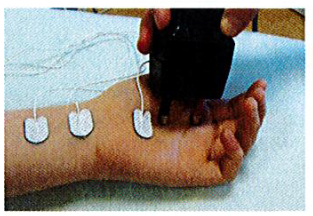
Photograph of electrodes on patients arm and hand
EMG: A fine needle is inserted into a muscle and readings are taken.
No blood is taken through the needle and nothing is injected. Two to three muscles may need to be examined (occasionally more) and the doctor will discuss this with you before the test.
Both tests are carried out by a Consultant Neurophysiologist (a medical professional who specialises in the investigation of neurological disease to discover nerve activity and neuromuscular damage).
How long will the test take?
The test will take about 45 minutes.
You are able to stay with your child throughout the test and a play specialist may be present to help occupy your child. Although we do have toys available, please feel free to bring your child favourite toy, book or handheld toy.
Are there any aftereffects?
There are no aftereffects. However, the muscles tested may feel slightly sore for a short time afterwards.
After the test your child can go back to school or nursery.
When will be advised of the results of the test?
The results of the test will be sent to your child’s consultant, and you will receive them at your next outpatient appointment.
What will happen if I decide that my child will not have this test?
It may affect the management of your child’s condition.
Are there any alternatives to this procedure?
There are no alternative procedures
Where is the department located?
Use the blue set of lifts directly next to the Concierge/help desk up to the 4th floor. Upon exiting the lift, turn right.
For further information
If you have any queries about the test or your appointment, please telephone the Neurophysiology Department on 0151 252 5375
This leaflet only gives general information. You must always discuss the individual treatment of your child with the appropriate member of staff. Do not rely on this leaflet alone for information about your child’s treatment.
This information can be made available in other languages and formats if requested.
Alder Hey Children’s NHS Foundation Trust


PIAG: 70