Information for Parents/Carer
Download the leaflet
Jaundice in Newborn babies (290kB)
What is Jaundice?
Jaundice is the yellow discoloration of the skin and the whites of the eyes in newborns. Yellowish discoloration may be noticed on palms of hands, soles of legs and gums. It’s usually harmless and often resolves without treatment. However, in some cases, it may be harmful if not identified and managed appropriately
Why Does Jaundice Happen?
Jaundice is caused by high levels of a yellow substance called bilirubin, which builds up when red blood cells break down. Newborns often get jaundice as they have more red blood cells than children or adults, and their livers are still developing and not fully ready to clear out bilirubin. Bilirubin travels to the liver where it is changed into a form that can be removed from the body through poo. This substance gives stools their yellow-brown color.
Sometimes the bilirubin levels rise too quickly or stays high, because of infection, a liver problem, or a mismatch between the baby’s and mother’s blood types. Too high bilirubin levels need medical attention because they can lead to more serious health issues.
Is Jaundice Common?
Yes. About 9 in 10 babies become jaundiced in their first week of life. Jaundice usually peaks at day 4 and fades by 2 weeks in full-term babies. If your baby is jaundiced, always tell your midwife or doctor.
How is Jaundice detected and measured?
Jaundice can be detected by looking at your baby’s skin and eyes.
It can be measured by using a special device on the baby’s head or chest, or through a small blood test taken from the heel.
Bilirubin levels are tracked on a graph. This helps determine whether treatment is needed or if levels need to be checked again later.
When and why does it need treatment
Treatment is typically required if:
Early Onset: Jaundice appearing within the first 24 hours after birth requires immediate medical evaluation. 
High Bilirubin Levels: If bilirubin levels are high or rising rapidly, treatment is needed to prevent potential complications like brain damage.
Prolonged Jaundice: If jaundice, even when mild, persists beyond 14 days in full-term babies or 21 days in premature babies, further assessment is necessary. 
Symptoms of Illness: If the baby is feeding poorly, appears lethargic, or has pale stools and/or dark urine, medical attention is required.
If your baby has any of the above, you should tell your midwife or doctor.
Prolonged Jaundice
Prolonged jaundice is defined as any jaundice of skin or eyes noted after more than 14 days in full-term babies or after more than 21 days in premature babies.
The most common cause of prolonged jaundice is secondary to breastfeeding (which is harmless) but it can be caused by rare conditions like liver problem which require timely treatment.
Next Steps for Prolonged Jaundice
Your baby will need a full assessment and likely blood tests to check for other causes that might explain the prolonged jaundice.
Even if your baby was seen for jaundice before the age of 14 days (or 21 days in babies born before 37 weeks gestation) a further assessment is essential to exclude an underlying health problem causing jaundice.
What to Watch For & When to Get Help
| Symptoms | Action |
| If your baby is; unwell including vomiting feeds persistently, taking less than half of usual feeds and/or has not had a wet nappy for 8 hours, stools are chalky or pale and urine is persistently dark | Call NHS 111 or attend your local emergency department |
| If your baby; has jaundice that is worsening, jaundice that has not gone away by day 14 (or day 21 if born prematurely) | Contact your health visitor or GP |
| If your baby; is well and jaundice is getting better, feeding and waking up normally | Contact your health visitor for advice |
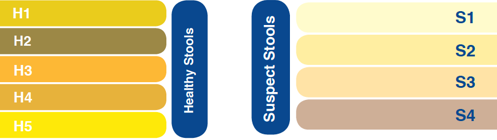
Healthy stools vs Pale stools
Need more help
https://www.nhs.uk/conditions/jaundice-newborn/
This leaflet only gives general information. You must always discuss the individual treatment of your child with the appropriate member of staff. Do not rely on this leaflet alone for information about your child’s treatment.
This information can be made available in other languages and formats if requested.
Alder Hey Children’s NHS Foundation Trust
Alder Hey
Eaton Road
Liverpool
L12 2AP

PIAG 88