
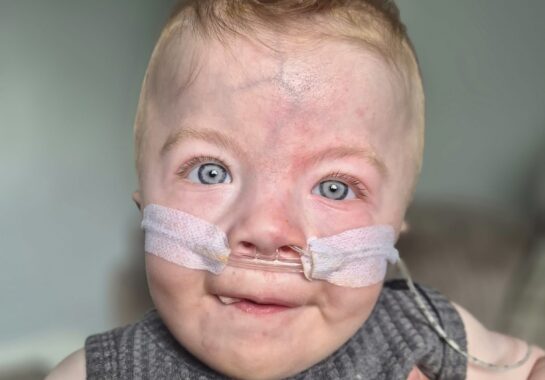
When 13-month-old Alaric was rushed to Alder Hey following a respiratory arrest linked to COVID-19, his family faced a frightening and uncertain time.
During his stay on the Paediatric Intensive Care Unit (PICU), Alaric received specialist treatment, was diagnosed with the rare genetic condition Cornelia de Lange Syndrome and took part in two national research studies intended to improve care for critically ill children.
Alaric is the youngest of two brothers and is described by his family as a bright, inquisitive and happy child, who often enjoys exploring his toys and spending time with his older brother Jacob.
In July 2025, Alaric suffered a respiratory arrest linked to COVID-19 and was initially treated at a hospital in North Wales. He was stabilised by the local team and NWTS ( North West and North Wales Transport service), and he was transferred as an emergency, to the Paediatric Intensive Care Unit (PICU) at Alder Hey.
Alaric spent 8 days on the PICU, where he received specialist treatment including ventilation, sedation, blood transfusions and close monitoring to support his recovery.
Since birth, he had experienced a number of complex health needs, including difficulties with feeding and weight gain, problems regulating his blood pressure and a hole in his heart. Previous genetic investigations had not identified an underlying cause.
Finding answers
Following discussions with the clinical team at Alder Hey, Alaric and both of his parents underwent genome sequencing.
Several weeks later, Alaric was diagnosed with Cornelia de Lange Syndrome also known as CdLS.
For his mum, Lian, finally receiving a diagnosis helped make sense of the health challenges Alaric had experienced since birth and gave the family the answers they had been searching for.
Cornelia de Lange Syndrome (CdLS) is a rare genetic condition that affects each child differently. It can impact growth, development and a range of body systems, with children often requiring specialist medical support throughout their lives.
Taking part in research
While Alaric was receiving care on PICU, his family were approached about taking part in two national research studies.
After speaking with the research team, Alaric’s parents agreed to his taking part. Neither study required additional procedures or changes to his medication or treatment.
Gastric-PICU
The Gastric-PICU study examined feeding practices among critically ill children receiving tube feeding into the stomach.
The study looked at whether children being fed through a feeding tube needed routine checks of the volume of stomach contents before every feed, or whether feeding without those checks is just as safe.
PRESSURE
The PRESSURE study examined how low blood pressure is managed in critically ill children.
Researchers wanted to find out whether allowing blood pressure to remain slightly lower than current practice could safely reduce the amount of medication and fluids some children receive in intensive care.
The study compared standard blood pressure management with lower blood pressure targets appropriate for the child’s age.
Helping future children
Although participation in research did not directly change Alaric’s treatment, the family saw it as an opportunity to contribute to better care for children in the future.
Alaric’s mum, Lian, said:
“Having the opportunity to take part in research at Alder Hey is amazing. By taking part, you are influencing the future care and treatment of children, and ensuring they receive the best possible care.
“Just like the two studies Alaric took part in, being part of research might not directly benefit you or your child, but it will benefit and change the care of poorly children in the future. To be able to give back and influence the healthcare children receive in the future is exactly what we want to do.
“For parents thinking about research, my honest advice is to get involved. If you have any questions, the teams at Alder Hey answer everything in a way you can really understand. All trials are different, but the ones Alaric took part in were not intrusive. Nothing needed to be changed or added to his care, but the outcomes from being enrolled and letting the researchers collect that data could change the life and care for children in the future.”
Supporting the whole family
Throughout Alaric’s admission, his family were able to remain closely involved in his care. His brother visited him, and the family were able to use facilities including the MediCinema, which helped maintain a sense of normality during a difficult and uncertain time.
Alaric also developed a strong connection with the musicians who visited PICU. His family noticed that Alaric would become completely absorbed in the music, providing moments of comfort and enjoyment during a difficult time.
Reflecting on the family’s experience, Lian said:
“Alder Hey is the only hospital that has a bigger family feel to it. I could bring Alaric’s brother Jacob, we could go to the MediCinema, and I could spend time with all my sons. Alder Hey was inclusive to all our needs.
“When we have appointments at Alder Hey, we never feel stressed. We just know we are going to be looked after.”
Since Alaric’s admission, the family have remained closely connected to Alder Hey and has supported Alder Hey Children’s Charity through fundraising, including Lian completing a 100km walk.
By sharing Alaric’s story and supporting clinical research, the family hope their experience will help improve care for other critically ill children and their families.
Alaric is doing really well. He has started waving, rolling over and pushing up onto his knees. He now enjoys watching Puffin Rock and Shrek as well as continuing to be curious and watching the world around him.