
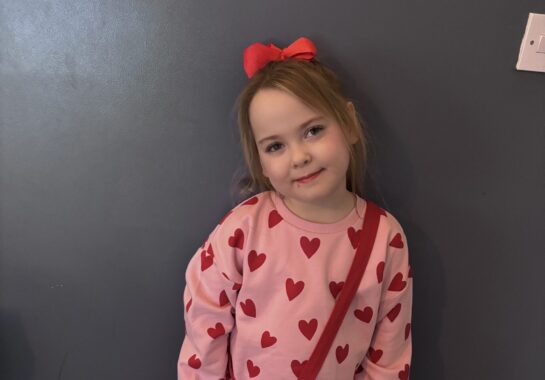
Five-year-old Harriet from Prenton, Wirral, never stops moving. She dances, swims, loves to draw, and leaves a little sparkle wherever she goes. Harriet throws herself into life with an infectious energy that makes everyone around her smile. In September 2025, Harriet’s health began to decline; she was struggling to walk and get out of bed.
In November 2025, Harriet was diagnosed with Juvenile Idiopathic Arthritis (JIA), specifically rheumatoid factor-positive Polyarticular JIA, the rarest subtype of the condition, affecting just 5% of those diagnosed. In Harriet’s case, the disease had taken hold across 21 of her joints, which meant she struggled to do the usual activities that any five-year-old would do.
JIA affects around 12,000 children and young people in the UK, causing significant pain and joint stiffness that can have a major impact on daily life and education. Treating the condition effectively is essential, not only to help children and young people return to their usual activities but also to prevent long-term joint damage.
“Harriet was in excruciating pain, and it seemed to only get worse and worse. It was really hard to watch because not only was our daughter suffering, but she could also no longer do the things she loved. She couldn’t dance or swim and she stopped being able to play with her friends. What was once my beautiful bouncy little girl could no longer get herself out of bed or even move around without being in extreme pain.”
Christie, Harriet’s mum.
Harriet is now six months into a 12-month research trial at Alder Hey, which could change the way children with JIA are treated across the UK.
Steroids and other prescribed medications are the most common treatment for children and young people with JIA in the UK. However, there is currently limited evidence as to whether steroids given by a drip are as effective as steroids taken by mouth. The research trial Harriet is taking part in directly compares these two approaches, measuring disease activity in each participant using the Juvenile Arthritis Disease Activity Score (JADAS10), at the start of the trial and again after six weeks. The findings will help doctors make more informed decisions about how to treat children with JIA in the future.
Harriet’s pain began during an ordinary day at school. In September 2025, she was taking part in a Forest School session when she suddenly became unable to bear weight on her right knee. On the same day, her parents rushed her to their local A&E. Initial blood tests and X-rays did not provide a clear explanation for her symptoms, and the family were advised to continue monitoring her condition while further investigations took place.
Over the following weeks, Harriet’s symptoms continued to worsen and spread beyond her knee. The little girl who had been dancing just weeks before could no longer get herself out of bed. Walking became increasingly painful, and Harriet also began struggling to regulate her temperature. Her pain became so severe that teachers at her school had to carry her to and from the toilet, and she was no longer able to play with her friends. Throughout this period, the family remained in regular contact with healthcare services as doctors worked to understand the cause of her symptoms, which can often be difficult to diagnose in the early stages.
During what became their final visit to A&E in that period, Harriet was admitted to hospital with high blood pressure, a high heart rate and an elevated temperature. Clinicians explained these symptoms may have been linked to the significant pain she was experiencing. Juvenile Idiopathic Arthritis (JIA) had been considered as one possible cause during Harriet’s assessments, but a formal diagnosis had not yet been made. It was during this admission that a referral was made to the rheumatology team at Alder Hey.
At her first appointment at Alder Hey, Harriet was diagnosed with JIA within minutes. Given the severity of her symptoms, she was kept in overnight for observation and it was during this same visit that her family were introduced to the possibility of taking part in a research trial.
Mum Christie said:
“As a parent, finally getting the diagnosis for Harriet was such a relief. When we came to Alder Hey pre-diagnosis, we had no idea what was causing our daughter so much pain. When we were told it was JIA, I was worried, but our doctor and their team put our minds at ease and gave us all the information we needed.
“When we were told about the research trial, it was an easy yes. There is so little understanding of conditions like JIA. We want to do everything we can to prevent this from happening to other families where their child is left in extreme pain. Taking part in a clinical trial means that in the future, a child in pain can be treated sooner and more effectively.”
The research trial Harriet is part of is completely randomised, meaning participants are assigned at random to receive either an IV steroid or oral steroid medication. Harriet began with the IV steroid drip and experienced relief almost immediately. Over the course of the first month, Harriet was moved to oral steroids, as the effects of the drip were wearing off quickly and leaving Harriet in pain. Six months in, Harriet is now in a healthy position, taking medications weekly and fortnightly.
What stood out to Harriet and her family was the environment in which the research took place. Rather than attending multiple clinics across the hospital, all of Harriet’s appointments took place in the Clinical Research Facility (CRF) at Alder Hey and the research trial was able to run alongside these appointments. The CRF provided a dedicated space where everything Harriet needed was in one place and where she could see the same familiar nurses and doctors at every visit. The hospital play team also supported every visit, helping Harriet feel calm and comfortable throughout.
“Research trials are essential for improving our understanding of treatments for children and young people. Studies such as the one Harriet is taking part in help us learn how effective different treatments are. Although steroids have been used in juvenile idiopathic arthritis (JIA) for many years, no trial has directly compared steroid tablets with steroids given via an intravenous drip. The STAR‑JIA study will compare how well these two treatment routes work, as well as their side‑effects. The results will help clinicians, patients and families make better shared decisions in the future about the most appropriate way to give steroid treatment.”
Associate Professor Clare Pain who is Co-Chief Research Investigator on STAR-JIA and Consultant Paediatric Rheumatologist at Alder Hey.
Harriet has always been curious about science, and receiving her diagnosis and taking part in the research trial has grown this curiosity further. She now has a book about JIA, that she reads with her friends, which is written in a way that they can all understand. She loves knowing she is teaching them about her rare condition. When a team of junior doctors visited Harriet during her admission at Alder Hey, she was also thrilled to be teaching them too.
Harriet knows that by taking part in the research trial, she is helping other children and doctors better understand the disease. Mum Christie explained:
“Harriet is so enthusiastic and proud to be taking part in research, she knows that with her help children in the future won’t have to go through pain like she did and that doctors will know exactly how to help.”
Harriet is now halfway through her 12-month trial. She is back swimming, dancing, cycling and playing with her little brother Luca, she has also recently learnt how to ride a scooter as she has better balance and mobility. Harriet is also now back to playing princess dress up, swapping and changing her dresses and playing with her makeup. The sparkle that Harriet briefly lost is back.