
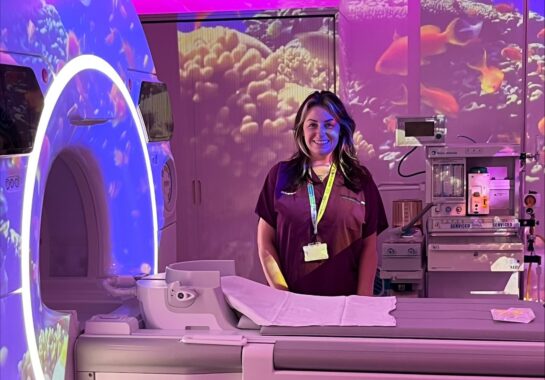
An MRI scanner can be intimidating for a child. It is big, noisy and unfamiliar, and we may be asking them to lie completely still while everything around them feels new.
That is why, for me, paediatric radiography is about much more than producing an image. It is about building trust, helping a child feel safe and turning what could be a frightening experience into something they can manage and sometimes even enjoy.
I began my career in adult hospitals, where I spent six years imaging and caring for adults. I learnt a great deal, but moving to Alder Hey completely changed my perspective. Four years later, I can say with certainty that this is the most rewarding job I have ever had.
Helping children feel safe
Working with children changes you. Their resilience is astonishing, their courage is humbling and the trust they place in us, often at a scary or unfamiliar moment, is something I never take for granted.
In paediatric imaging, the technology is complex, but the heart of the job is simple: help children feel safe.
Our team works hard to create a positive and calming experience, particularly for young people who need repeated scans. Children can watch a favourite programme or film during their scan, while headphones help reduce some of the unfamiliar noise. We speak to them throughout, so they understand what is happening and know they are not alone. When appropriate, parents and carers can stay nearby too.
Our environment has also been designed with children in mind. We have ambient lighting, cinematic wall projections, mirrors that allow children to see beyond the scanner and a quiet space where babies can settle. Virtual reality headsets can also help children understand what entering an MRI scanner may feel like before the real scan begins.
It is a clinical space, but it feels warm, gentle, and child centred.
Many children return to us regularly. Over time, we get to know them and their families and learn what helps each child feel comfortable. Turning a potentially stressful appointment into a calmer experience is one of the most rewarding parts of the role.
Inside MRI and CT
I work across both MRI and CT, and each type of imaging has different strengths.
CT uses X-rays to produce detailed images very quickly, which can be particularly valuable in trauma care. MRI scans take longer and can feel bigger and louder, but the level of detail they provide, especially for soft tissue, is incredible.
Because the MRI magnet remains switched on, safety is essential. Everyone entering the scanner room completes a detailed checklist, and we use specialist MRI-compatible equipment.
Inside the scanner, small details make a significant difference. Foam pads, earplugs, headphones and a child’s chosen film can help them relax. New cushions and inflatable supports have been especially helpful for newborn babies, who often settle beautifully when they feel snug and supported.
We communicate with children through a microphone while they are inside the scanner. Those who feel anxious can also be given a buzzer to squeeze if they need us to pause. Giving a child that sense of control can completely change how they feel about the scan.
Discovering radiology research
For the past 18 months, I have also been working in a research role, and every day feels like a learning day.
Moving from purely clinical work into research has shown me an entirely new side of radiology. I have helped develop scanning protocols, test new sequences with volunteers and work with medical physicists to optimise image quality.
My role also includes transferring images, anonymising information for studies and attending meetings about upcoming trials. I have worked with university researchers and external organisations using our scanners to test equipment and explore new ideas.
My colleagues Heather and Professor Shivaram Avula and I form the core cross-sectional imaging research team. Together, we have worked hard to establish this new service within the department. We currently support more than 30 live studies, alongside over 20 studies at different stages of set-up.
Research extends across the wider radiology department, with colleagues in X-ray, nuclear medicine, ultrasound and DEXA imaging also contributing to studies.
The range of research we support is remarkable. It includes studies monitoring how children respond to cancer treatment and advanced cardiac imaging that could help identify early signs of life-changing conditions. Knowing that the images we produce may contribute to future treatments is deeply rewarding.
Imaging designed around children
Some studies involve scanning newborn babies using our ‘feed and wrap’ technique. The baby is settled, fed and wrapped warmly before being scanned while sleeping naturally. It is a gentle approach designed around the baby’s needs.
One of the most fascinating parts of our work is functional brain imaging.
Functional MRI, or fMRI, helps us see which areas of the brain are active during particular tasks. A participant might listen to a sound or move the fingers on one hand, allowing us to see activity in the parts of the brain involved in hearing or movement.
Clinically, this can be invaluable when planning surgery, helping teams understand where important functions are located in the brain. In research, it allows us to explore the brain in ways that would have seemed impossible only a few decades ago.
We also try to make radiography and research more accessible. For World Radiography Day, children could explore a miniature scanner and take images of their toys, while families and staff worked together to build a LEGO MRI scanner in the hospital atrium.
Activities like these help remove some of the mystery around imaging and show children what happens behind the scenes.
Being part of something bigger
Working in paediatric radiography, particularly in research, makes me feel part of something bigger.
Every scan, every protocol we develop and every collaboration contributes to knowledge that could help children now and long into the future.
The technology may be complex, but the purpose remains very human: helping children feel safe, supporting their care and using what we learn to make things better for those who come next.
It is a privilege to be part of that story.
Kirsty