
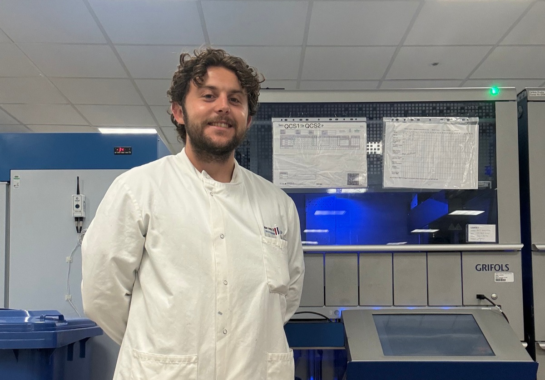
When a child comes to Alder Hey, there are lots of different professionals involved in their care – doctors, nurses, play specialists, radiographers and many more.
But there is one team they may never meet, even though we can play an important role in care: biomedical scientists.
We work behind the scenes in the hospital laboratory, studying samples and looking for clues about what is happening inside a child’s body.
If you have ever had a blood test, that tiny tube has gone on one important journey. I like to think of it as a message from the body and we are the people who help to read it.
What happens to a blood sample?
Once blood has been taken, the sample starts its journey to the laboratory. Sometimes it arrives by hand. Sometimes it travels through a tube system that carries the sample around the hospital, a bit like a miniature rollercoaster!
When it reaches us, we check everything carefully. We make sure details such as the child’s name, date of birth and hospital or NHS numbers match, and confirm which tests the clinical team have requested.
It might sound like a small step, but it is incredibly important. Every sample belongs to a real child, and we want to get everything right.
A single result can help a doctor decide whether a child needs medicine, another test or sometimes no treatment at all. If something doesn’t look right, we investigate before going any further.
Biomedical scientist are sometimes described as the “guardians of quality”. I like that, it makes us sound like a little superhero team.
Why can one small tube of blood tell us so much?
Blood is fascinating. One of the reasons I became a biomedical scientist was the idea that one tiny sample could tell us so much about a person.
Blood carries oxygen, helps fight infection, transports nutrients and supports healing. I like to imagine it as a busy road network, with lots of different vehicles doing different jobs.
Red blood cells carry oxygen, white blood cells help fight germs, and your platelets help blood to clot. There are also many different chemicals and proteins travelling alongside them.
When we test blood, we are looking at those different parts and searching for clues. Some tests look for signs of infection or disease, others show us how well organs are working or measure things such as iron or sugar levels.
Each result gives the clinical team another piece of information to help hem understand what is happening and decide what care a child may need.
Meet the machines that help us
Once a sample has been checked into the laboratory, it may go onto an analyser. These sophisticated machines can carry out lots of tests, using methods such as spinning samples, shining light through them or using tiny chemical reactions.
Many tests can be completed quickly, but the machines don’t work alone.
Biomedical scientists check they are working correctly and review the results before they are released. If something appears unusual, we investigate.
That might mean repeating a test, carrying out additional work manually, looking at blood under a microscope or speaking to the clinical team to understand a little more about what is happening.
A blood test result is only one part of the picture. The child behind it matters the most.
Why testing children is different
Children are not simply smaller adults. Their bodies change enormously as they grow, so a result that is normal for a newborn baby may be very different from what we would expect in a teenager.
With babies and children, taking blood can be much more difficult, and sometimes the sample that reaches us is incredibly small. That means every drop matters.
We know that behind every tube is a child who may have been nervous, cried, needed someone to hold their hand or felt incredibly proud of themselves after. To us, every sample represents a moment of courage.
Sometimes every minute matters
Some blood tests are particularly urgent. A baby with jaundice may need their bilirubin level checked quickly so the clinical team can decide what treatment is needed. A child with very low red blood cells or platelets may also need treatment quickly.
That is one of the reasons our laboratory operates 24 hours a day, seven days a week.
Even at 4am, biomedical scientist are working behind the scenes, testing samples and making sure urgent results reach clinical teams quickly.
Why I love being a biomedical scientist at Alder Hey
Working as a biomedical scientist in a children’s hospital is both challenging and rewarding. Children’s samples may be tiny, but each one has its own story.
Every test we carry out could help a doctor make a decision, understand what is happening or give a child the treatment they need.
So the next time you have a blood test, remember your sample doesn’t simply disappear. It’s starting its own little journey through the laboratory, where biomedical scientists like me work on understanding the message your body has sent.
– Joseph Furnival