Information Sheet for Parents and Carers
Would you like to take part in a study to help improve confidence in parents giving medicine to babies at home? Please read the following information carefully.
The research team would be happy to answer any questions you might have and to explain anything that isn’t clear. Our contact details are at the bottom of this information sheet.
We need to make sure that you understand all the information about this study before you take part. You may also want to talk to other people about this study.
What is this study about?
In our previous study (PADDINGToN-1) we co-designed medicine information with parents and carers of babies born premature or sick. These resources are aimed to support parents giving medicines to their baby at home following discharge from a neonatal unit. Parents and carers told us that they worry about making mistakes when giving medicines to their baby and cannot always find reliable information to help them when they have questions about medicines.
This study will use the medicine information resources developed in PADDINGToN-1. We will share the resources with parents and carers before their baby is discharged from the neonatal unit. We want to find out whether the resources help parents and carers feel more confident and less anxious about giving medicines to their baby after they go home.
Our current study is called PADDINGToN-2 and is composed of one main study and three smaller studies.
Why are we doing this study?
We are designing a larger study to find out if using the PADDINGToN-1 medicines information/resources helps to reduce parents’ and carers’ anxiety, improve confidence and improve safety. To do this, we are trying to find out answers to some questions, including:
- What is the best way to get parents and carers to take part in our study?
- How do we involve a wide range of parents and carers?
- How do we make it easy for parents and carers to take part?
- How do we keep parents and carers engaged throughout the study?
- What is the best way to collect information about parents’ and carers’ anxiety and confidence about medicines?
The answers we get to these questions will help us design a larger study (PADDINGToN-3) to find out whether using the PADDINGToN-1 medicines information resources reduces parents’ and carers’ anxiety, improves their confidence and improves safety.
The PADDINGToN-2 study is made up of four parts.
- Feasibility study. This is the main part of PADDINGToN-2 and involves parents and carers answering brief questionnaires before and after their baby has been discharged home. There is further information below.
And three extra optional parts. You could take part in all three or just some of them.
- Filling in a diary: diary study completed over the 12 weeks
- Conversation at a clinic visit: completed at 4 weeks after discharge home
- Interview about the medicines information – Reflection/feedback and acceptability: completed within a month of completing the main (feasibility) study
There is a further option to just answer some questions about your baby and their medicines before leaving hospital and then speak to a member of the research team 4-8 weeks after discharge.
Why have I been asked to take part?
You have been asked to take part because you are a parent of a baby who will be discharged home with at least one medicine. This means that we would like to understand how you are feeling about giving your baby medicines before you leave the unit, and then whether the resources we will provide you with, help you to feel more confident.
What will the study involve?
We hope to recruit 75 parents to our main feasibility study across the five study sites in Liverpool, Wirral, Warrington and Leeds.
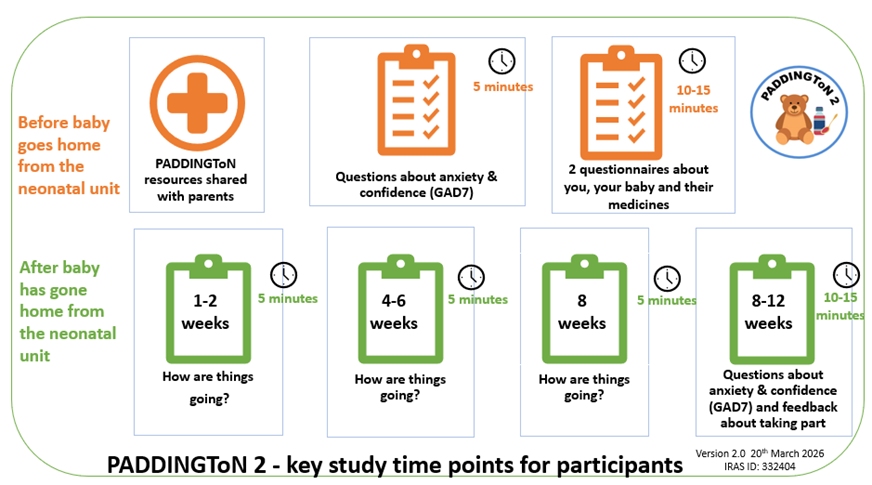
Before going home from hospital, the PADDINGToN medicines information resources will be shared with you by healthcare professionals in the hospital. After this, one of our research team would like to ask you some questions. The questions will be about you and your baby’s journey in the neonatal unit, and some questions about how anxious or confident in general and how you feel about giving medicines to your baby at home. The researcher will meet with you somewhere convenient for you, and at a time that fits in with you and your family. The conversation should take between 15-30 minutes and can be undertaken following discharge.
After you have gone home, the research team will keep in touch with you regularly for 2-3 months. The researcher will discuss with you how to make this as easy as possible for you. On three occasions, we will ask you to answer some questions about how you are getting on with your baby’s medicines. This can be done electronically, on paper or via phone when the researcher will write down your answers, whatever is best for you. Answering these questions shouldn’t take more than 5 minutes.
Every few weeks we will catch-up with you, to ask some general questions about how you are getting on with your baby’s medicines. Two to three months after you get home, we will ask you same questions we asked you just before you were discharged, so we can compare how you are feeling now to how you were feeling then.
The diagram provides an outline of the stages of our study and when we will be contacting you if you take part.
What happens next?
Parents and carers who can take part in this study will be identified by clinical staff involved in the routine care of their baby. Adverts will also be displayed in neonatal units. If your baby is on the neonatal unit and you are interested in the study, clinical staff will ask your permission to pass on your name and a suggested contact method, to the research team.
A member of the study team will then contact you to discuss the study and check you are eligible to take part. This discussion may happen face-to-face, via the telephone or virtually, depending on what is available/most appropriate for you.
You will have as much time as you need to think about taking part in this study. If you are happy to take part, then a member of the study team will gain informed consent. This can be written or e-consent and will be done face-to-face or virtually using appropriate secure platforms.
Are there any risks/ benefits to taking part?
If you take part in this study, the research team will stay in contact with you for the first 2-3 months after you are discharged. If you have any questions about medicines during this period, we may be able to provide advice or put you in touch with someone who can help you.
To find out about your anxiety and confidence about medicines, we will ask questions about how you are getting on. We will use questionnaires that other researchers have tested and ask other parents to check the wording of any questions we develop ourselves. We do not think these questions will be upsetting, but if you do not want to answer any questions, that is fine. If you do become upset, we will provide you with details of support available.
We will not be collecting any participant identifiable information and so any information collected will be anonymous. The information you give us will be used to help us improve the design of our future study. We hope using the PADDINGToN medicines information resources will be beneficial to parents/carers whose baby has been in a neonatal unit.
Do I have to take part?
No, it is up to you if you want to take part or not. Whether you choose to take part or not, it will not affect the standard of care you or your child receives. If you have any questions about taking part, please just contact a member of the study team.
If you do decide to take part in this study, we will notify your GP of your participation for their records.
You can choose to take part in the feasibility study only or the feasibility study plus some or all of the additional studies.
Can I change my mind?
Yes, you can change your mind and stop being involved in the study at any time. If you do stop taking part, we will ask if you are willing to give us a reason as this will help us with the design of our future study. You do not have to give a reason if you would prefer not to.
How else can I help the study?
If you are interested, you could help us by answering some more questions. We will ask about 10-15 parents to help us in this way. The parents who help answer the extra questions will be asked about any concerns they have about the safety of medicines and how often they contact the hospital, GP, health visitor etc. A separate information sheet will be given to you about the optional parts of the study.
Other important information about the research
Who is doing this research?
This research is being carried out by the Paediatric Medicines Research Unit (PMRU) at Alder Hey Children’s NHS Foundation Trust (FT), Liverpool Women’s NHS FT, Wirral University Teaching Hospital NHS FT, Leeds Teaching Hospitals NHS Trust, Warrington and Halton Teaching Hospitals Foundation Trust, Edge Hill University, University of Liverpool, the Royal College of Surgeons of Ireland, vCreate® and Bliss.
What will happen once the research ends?
All of the information collected will be analysed by the PMRU team at Alder Hey Children’s NHS Foundation Trust.
We hope that this study will help us design a larger study (PADDINGToN-3) to find out whether using the PADDINGToN medicines information resources reduce parents’/carers’ anxiety, improves their confidence and improves safe use of medicines in the home environment.
We plan to share our results in journals and conferences, teaching sessions and at other meetings and via social media. We may use quotes from interviews, however you or your child will not be identified in any report or publication.
Once the study is finished, we will create a report which summarises the results and this will be published on the PMRU website for you to read if you wish. You can access this here: https://alderhey.nhs.uk/research/paediatric-medicines-research-unit
Will the information you give be kept private?
Anything you tell us will be kept confidential. We will not tell anyone outside of the study team about what you have told us unless it is completely anonymised or we are worried about your child’s safety. Data we collect will be completely anonymised using a unique reference number which will be allocated from, and held within, a secure network at Alder Hey. We may use a third-party external messaging service to send text messages but your data will not be stored on this platform. All the information about your participation in this study will be kept confidential and in accordance with the General Data Protection Regulation (GDPR).
In line with GDPR, as Alder Hey Children’s Hospital is the Sponsor for this research study and is based in the United Kingdom, they will be using information from you in order to undertake this study and will act as the data controller for this study. This means that they are responsible for looking after your information and using it properly. Alder Hey Children’s NHS FT will keep information about you for 10 years after the study has finished. This is to allow the study to be reviewed by the authorities after it is finished.
Please note that no identifiable information will be collected during this study, except for recording your name on the consent form to show you are happy to take part. You will not be asked for your child’s name and all data you provide will be anonymous.
Your rights to access, change or move your information are limited, as the Sponsor organisation need to manage this information in specific ways in order for the research to be reliable and accurate. To safeguard your rights, we have chosen to collect no personally identifiable information. The only people outside the immediate research team who will have access to anonymous information about you will be people who need to audit the data collection process.
You can find out more about how Alder Hey Children’s Hospital uses your information by contacting the Alder Hey Data Protection Officer on [email protected].
At the end of the study, the documentation held at Alder Hey Children’s NHS FT will be stored securely for 10 years after the study finishes, within the Trust’s secure network, in line with Alder Hey’s Trust data storage procedures.
Has the study been checked?
Yes. Within the UK the study has been reviewed by the Health Research Authority, a Research Ethics Committee and Alder Hey Children’s NHS FT to make sure it is safe and ethical.
Who do I ask about this?
If you have any questions, please contact a member of the study team using the contact details at the end of this information leaflet.
What if something goes wrong?
If you are unhappy, or have concerns about any aspect of this study, or would like to make a complaint, you should speak to the PALS team on 0151 2525374, or via email [email protected]. PALS can also be contacted if you have any questions or queries about research in general.
Study contact details:
PADDINGToN Study Team on 0151 252 5570
Thank you for taking the time to read this information sheet.
