
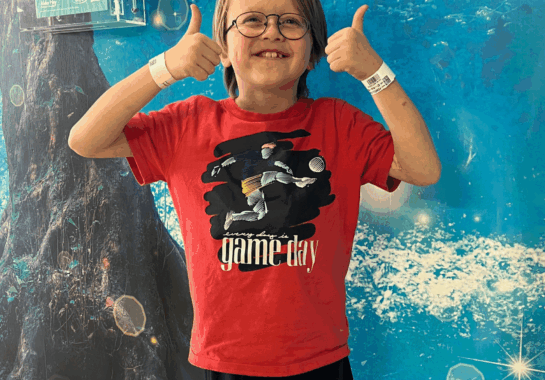
Eight-year-old Harry from Warrington has chronic kidney disease (CKD) stage 5 and is currently being treated with peritoneal dialysis. Harry is currently participating in a research trial at Alder Hey, evaluating a new medicine for children diagnosed with chronic kidney disease and anaemia.
The research trial examines how effective the new medication is in treating anaemia in children with CKD. This medication is in tablet form, and current treatments are given by injection.
CKD is a long-term condition, where the kidneys gradually lose their ability to function and currently affects 1 in 10 people around the world. Anaemia of CKD means the body does not have enough healthy red blood cells and affects 1 in 5 people who have been diagnosed with CKD.
Following birth, doctors at Alder Hey diagnosed Harry with posterior urethral valves at seven days old. In this condition, there is an obstruction to the flow of urine from the bladder, which begins before birth and affects kidney development. In Harry’s case, his kidneys did not develop even after the obstruction was removed, resulting in poor kidney function and the need for dialysis. Harry has attended Alder Hey for multiple treatments, operations and appointments, including having a catheter fitted to empty his bladder and a dialysis catheter through which he has dialysis at home each night.
Prior to starting the research trial, Harry’s Mum, Lauren, needed to inject Harry once a week to help manage the anaemia, which was something Harry didn’t like. Every Monday, Harry would be worried and upset about his Mum injecting him with the medication he needed. The research trial enabled Harry to swap the injection for a new medication, which Harry takes by mouth three times a week.
“Harry being diagnosed with chronic kidney disease and kidney failure has been really hard. Prior to starting the research trial, I had to inject him every Monday and he hated it. When Dr Jones put us forward for the research trial, I was a little nervous – I didn’t know what to expect.”
Lauren, Harry’s Mum
Lauren continued: “The doctors and medical teams at Alder Hey explained everything clearly to me and answered any questions myself and Harry had. Harry was really excited at the opportunity to try something other than the injection and to see if it helps to make him feel better. He was also excited to try something other than the injection, and although he had never taken medication orally before, he really took to the medication and it became a really positive experience for him.”
Since starting the trial in July 2025, Harry has continued to enjoy his hobbies and school activities. He regularly plays Roblox and Fortnite and enjoys riding his bike and dancing to music. At school, Harry is doing really well, having lots of friends and enjoying learning.
Dr Jones, Consultant Paediatric Nephrologist, said: “Children born with chronic kidney disease have significant health needs, including the need for taking multiple medications which may require an injection; special diets which may not be palatable; significant fluid restrictions and multiple appointments which include blood tests.”
“Some children, like Harry, will require dialysis, which, although it helps to control the blood salts, only provides about 10 per cent of normal kidney function and many children will feel nauseous, tired and find it difficult to concentrate. Any improvement to their care such as avoiding regular injections through this research trial is important.”
Lauren also added: “The research trial has been really positive for Harry. I have seen so many more positives taking the medicine over the injection. Not only in improving Harry’s health but I can also see a positive difference in his anxiety.”
“At first it was scary, but being part of research is actually really fun! I am trying a new medicine that in the future, will help lots of children like me feel better. I feel like a scientist and a superhero!”
8 year old Harry
If you would like to find out more about Research at Alder Hey, go to our research section.